The Origins of Courts
Week 1
Definitions
What are courts?
Mohr (1976, 623) defines courts as
a family of passive governmental institutions one of whose prominent functions is the settlement of disputes, distinguished from other governmental institutions by a commitment to decide impartially, after presentation of proofs and arguments by contending parties, and to be able to justify decisions according to pre-existing rule.
What are courts?
Let’s distil the main elements from this definition:
“governmental”
“institutions” (= organizations)
prominent function = dispute settlement
impartiality
arbiter between parties
justify decisions with pre-existing rules
What are courts?
“governmental”
could exclude international courts if understood strictly
seemingly excludes private adjudication and mediation, even if a strong public interest function exists (e.g. Meta Oversight Board)
a court is an organization
a single individual is not a court; can there be ‘judges’ without courts? E.g. travelling judges in far-away Roman and Byzantine provinces
organizations have some degree of permanency, physical resources (buildings, staff, etc.), rules of procedure, informal practices
a court settles disputes between parties, including private and public entities
- arbitrators and mediators also resolve disputes, in less rigid settings
What are courts?
courts need to be impartial to maintain legitimacy
- normative requirement to decide impartially, practical requirement to also appear impartial
courts decide after hearing evidence and arguments from contending parties
- the parties present evidence and argue their side of the case; the court decides the case as it is presented to it
decisions are motivated with reference to pre-existing rules
laws and precedents should make rulings predictable
need to justify decisions in this way should limit judicial power (discretion)
Alternative definition
The Court of Justice of the European Union has developed its own definition of a ‘court or tribunal’:
[…] in order to determine whether a body making a reference is a ‘court or tribunal’ […] the Court takes account of a number of factors, such as, inter alia, whether the body is established by law, whether it is permanent, whether its jurisdiction is compulsory, whether its procedure is inter partes, whether it applies rules of law and whether it is independent […]1
Module and assessment
Module
all the information is on the website
lectures + discussion seminars
3000-word research paper (100%)
think, read, speak (to each other + to me) and write about courts for several hours each week
- how do courts relate to your existing interests? geographically, temporally, thematically
No devices
no laptops, tablets or phones in lectures or seminars
bad for concentration, yours and that of the people around you (Sana, Weston, and Cepeda 2013)
bad for retention, as we remember less of what we only half attend to (Glass and Kang 2019)
technology and distractions are everywhere, so this gives us two hours a week of protected time and space
the only exception is where your SORA requires a device
Seminars
three mandatory readings a week
prepare following the instructions on the website
bring printed copies of the readings with your own annotations, plus hand-written or printed notes
a randomly selected student introduces the readings and kicks off the discussion
- your normal discussion notes are enough to do this
Methods
much cutting-edge work uses sophisticated methods you will be unfamiliar with
grappling with difficult texts is a great learning opportunity and a valuable skill in itself
the point is not to understand every detail of every model and statistical procedure
- but to distil the key points from difficult readings
Methods
- much of social science is about the impact of policies and decisions (treatments), while grappling with selection
\[ \begin{aligned} X &= g(Z) \\ Y &= f(X, Z) \end{aligned} \]
\(X\) treatment, \(Y\) outcome, \(Z\) everything else shaping both, observed or not
selection can be resolved
by design, e.g. experiments, with fewer assumptions
by adjustment, e.g. matching, with more assumptions
we care less about the detail of \(g\) and \(f\) than about research designs
- designs determine the quality of the evidence on a given question
Assessment
you should start working on your research paper right now
- see suggested timeline on the website
the assessment is demanding, but the best work will be adequately rewarded
- if you do it properly, you will learn a lot
previous years:
best mark 80: relevant question, grounded in literature, original data collection, appropriate analytical methods, meticulous attention to detail
worst mark 19: AI slop, vague research question, poor theory, poor methods, undocumented analysis
Assessment
research-oriented => suitable for expanding into your dissertation
no restrictions on geographical or temporal focus
- but generally a good idea to venture into under-researched jurisdictions
coming up with something original requires first learning about what is already out there
| Data | |||
|---|---|---|---|
| Existing | Novel | ||
| Theory | Existing | Nope | Good |
| Novel | Good | Okay |
Brief history of courts
Brief history of courts
impartial third-party arbiters who stop conflicts appear among captive chimpanzees (von Rohr et al. 2012)
a key concern of early societies such as ancient Greece was the regulation of retaliation and blood feuds (Wolff 1946)
- institutionalized retribution, most famously the Code of Hammurabi (“eye for an eye”) (Slanski 2012)
Mesopotamia had written law collections by 2100 BCE and sophisticated judicial institutions (Slanski 2012)
- multiple jurisdictions, widespread arbitration, public trials with evidence and witnesses
Lawsuit in 20th–19th century BCE

Record of a lawsuit on a cuneiform tablet: two merchants accuse each other of stealing the contents of a private archive (Met Museum)
Ancient and modern courts
| Greece | Rome | Modern | |
|---|---|---|---|
| Judges | ❌ | ✅ | ✅✅✅ |
| Juries | ✅✅ | ✅ | ✅ |
| Appeals | Limited | ✅ | ✅ |
| Lawyers | ❌ | ✅ | ✅✅ |
| Oratory | ✅✅ | ✅ | ✅ |
| Form | Oral | Oral | Written |
| Precedents | Very limited | Limited | Common |
Pre-modern “trials”
trial by oath, by ordeal and by combat mixed law with religious belief
Leeson (2012) argues that ordeals were effective judicial tools

Trial by boiling water, illustration from a Sachsenspiegel manuscript
Common and civil law
common law: from the 1160s royal judges sent across England replaced many local customs with law common to the whole kingdom
- it empowered judges and made them a distinct professional class, though independence was guaranteed only in 1701
civil law: primacy of codified rules, from the Corpus Juris Civilis (534 CE) to the Napoleonic Code (1804)
- no binding precedent – the judge as “the mouth that pronounces the words of the law” (Montesquieu 1748)
Modern courts
civil and common law traditions have converged
civil law judges treat previous decisions as de facto precedents
statutes are now the main source of new rules in common law countries
judicial independence is the cornerstone of the modern judiciary; juries and judicial review vary
courts are central to the rule of law in democracies
vertical disputes (state v individuals) and horizontal ones (between individuals)
upholding the constitution and fundamental rights
From constitutions to judicial review
Rise of constitutions
Judicial review
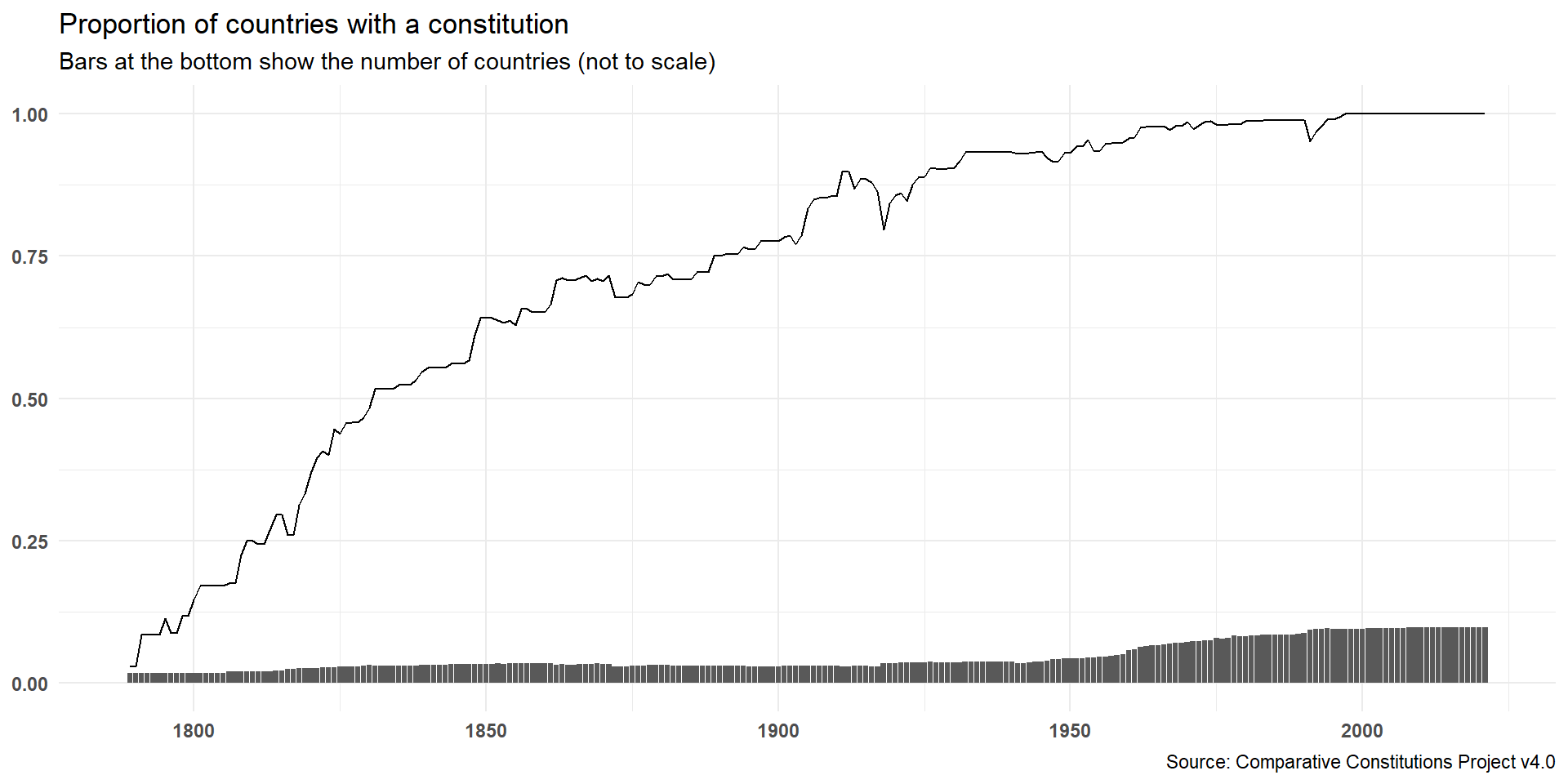
the proliferation of constitutions and rights was accompanied by an expansion in (peak) courts’ power through judicial review (Ginsburg and Versteeg 2014)
the idea of distinguishing “higher” rules – historically often tied to religion (natural law) – and “lower” rules dates back to at least ancient Greece
constitutions made natural law into (interpretable, enforceable) positive law
this is a core source of political tension under constitutionalism: how can anyone (i.e. a court) but the Hobbesian sovereign decide what is permitted?
simply pointing to the law does not suffice – language is full of ambiguities, someone needs to interpret and apply it
Marbury v Madison (1803)
outgoing president John Adams appointed judges days before his term was over
some of the appointment documents were not delivered before Thomas Jefferson took office
the new Secretary of State, James Madison, was told by Jefferson not to deliver them
one of the appointees, William Marbury, filed a lawsuit in late 1801
the Supreme Court established its power to invalidate unconstitutional statutes but found it lacked jurisdiction to order delivery
Marbury v Madison (1803)
It is emphatically the province and duty of the judicial department to say what the law is.1
Marbury v Madison (1803)
judicial politics on many fronts
born out of a court packing effort
questionable impartiality of the opinion writer
case re-framed as a question of statutory constitutionality
navigating political conflict (between the Federalists and the Democratic-Republicans) and likelihood of compliance
seeking to strengthen the Court’s authority
Judicialization of politics
Judicialization of politics
the process of power shifting towards courts (and legal institutions) from other branches of government, especially the legislature (Ferejohn 2002)
courts become an important site for settling issues of public policy
political actors and action become constrained by court rulings
who should ultimately decide matters of public policy?
Judicialization
three ways courts have become empowered vis-à-vis the legislatures (Ferejohn 2002):
- creation of substantive limits on legislative power
- policy-making through litigation and judicial precedent
- the regulation of political activity and enforcement of standards
Judicialization
There is hardly any political question in the United States that sooner or later does not turn into a judicial question. From that, the obligation that the parties find in their daily polemics to borrow ideas and language from the judicial system. Since most public men are or have formerly been jurists, they make the habits and the turn of ideas that belong to jurists pass into the handling of public affairs. The jury ends up by familiarizing all classes with them. Thus, judicial language becomes, in a way, the common language; so the spirit of the jurist, born inside the schools and courtrooms, spreads little by little beyond their confines; it infiltrates all of society, so to speak; it descends to the lowest ranks, and the entire people finishes by acquiring a part of the habits and tastes of the magistrate.
Alexis de Tocqueville, Democracy in America (1835)
What courts decide today
Policy: e.g. rulings on the “pesification” of the Argentinian economy (2003-4)
Electoral: Romania’s Constitutional Court annulled the first round of the 2024 presidential election; Brazil’s electoral court barred Bolsonaro from office until 2030 (2023)
Constitutional: South Africa’s Constitutional Court refused to certify the new constitution until it was amended (1996); Israel’s Supreme Court struck down the 2023 amendment barring reasonableness review of government decisions (2024)
Identity: the Turkish Constitutional Court’s party bans (1998-2009); India’s Supreme Court on Ayodhya (2019)
Executives: South Korea’s Constitutional Court upheld the impeachment of President Yoon (2025)
- none of these courts commands an army or a budget
Why would the losing side accept the verdict of a third party?
References

POLS0113: Judicial Politics