Courts in Liberal Democracy
Week 2
Why should unelected judges have the last word?
this week we look at
why states establish courts
who governs if courts have the last word
the rule of law and the separation of powers
judicial review and the counter-majoritarian difficulty
judicial power and judicial independence
Why courts get power
Why would states establish courts?
someone needs to adjudicate disputes
this could be the ruler, or a person appointed by the executive
- but other actors would not perceive the ruler as an impartial adjudicator (Shapiro 1981)
committing to an independent court instead makes adjudication more credible
- and more attractive to other actors
Credible commitments
an independent court is a signal that the executive pledges to abide by its decisions
credible commitments benefit the government
the English crown could borrow more cheaply after the Glorious Revolution (North and Weingast 1989)
secure property rights help the economy develop (North and Weingast 1989)
internationally, treaties and courts work in a similar way
- but new democracies also use them to lock in democracy against future governments (Moravcsik 2000)
Who governs?
Who ultimately governs?
empowering courts raises the question of who ultimately governs
if governments must abide by what courts say, and courts have the last word, aren’t courts the real rulers?
for Hobbes, whoever has the last word is the sovereign
- setting a judge above the sovereign “is to make a new sovereign” (Hobbes 1651, ch. 29)
How do liberal democracies manage the tension?
independent courts on one side, representative government enacting the will of the people on the other
liberal democracies manage the tension through constitutionalism and the separation of powers
quite successful at maintaining the illusion that everyone is subject to the law (the rule of law)
yet subjecting legislative power to judicial power is perhaps particularly normatively objectionable (Waldron 2006, 2021)
What is the rule of law?
thin (formal) conceptions: law must be general, public, prospective, clear, consistent, possible to comply with, stable and actually applied, the eight desiderata of Fuller (1964)
- they say nothing about the content of law, so regimes with morally objectionable laws can satisfy them (Craig 2017)
thick (substantive) conceptions add rights that distinguish good laws from bad ones (Craig 2017)
courts feature in both, guaranteeing consistent application (thin) and guarding rights (thick)
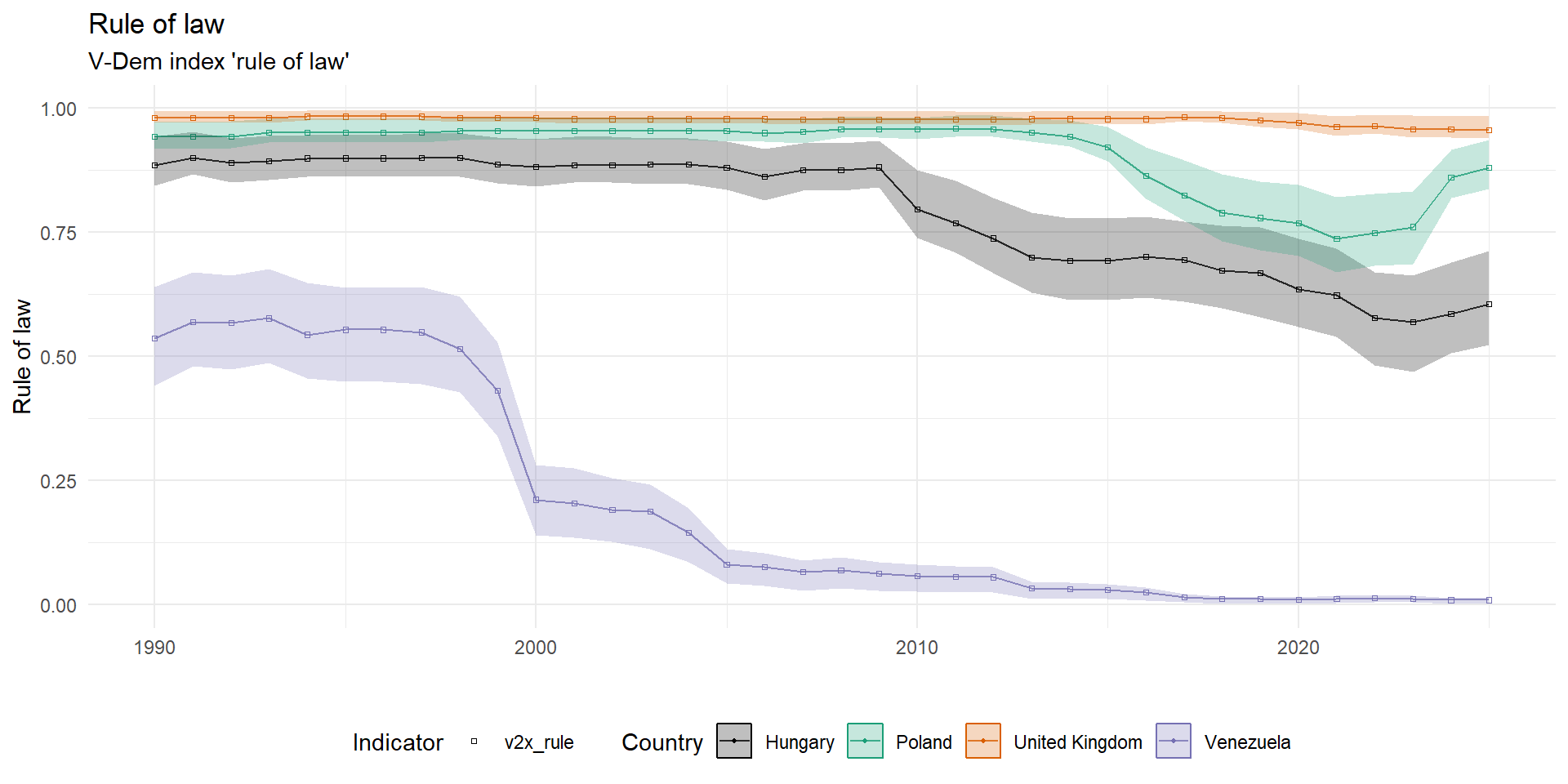
Rule of law in comparative perspective
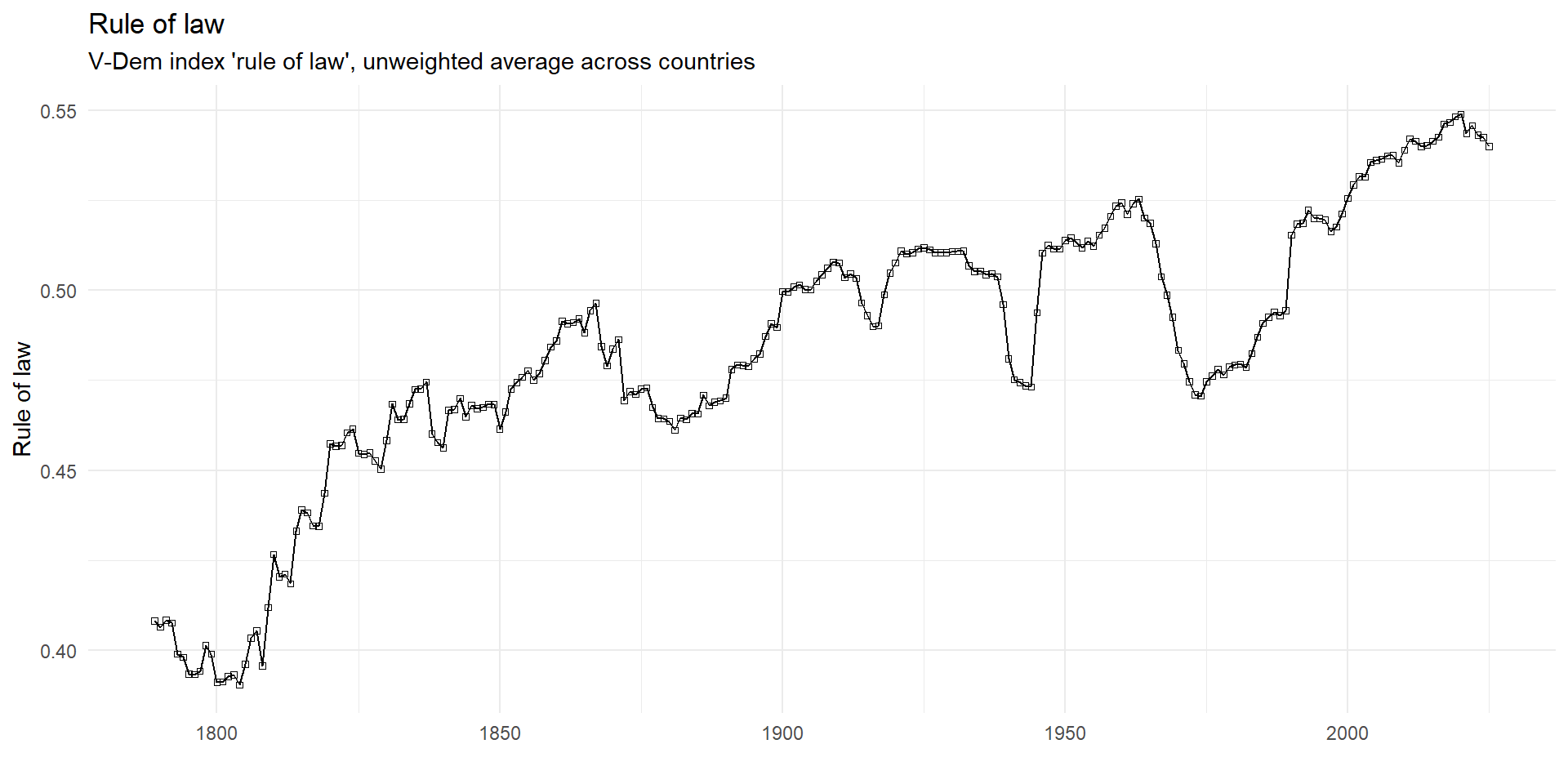
Rule of law in comparative perspective
Separation of powers and judicial review
Separation of powers
separation of powers: legislative, executive and judicial functions sit with separate branches, staffed by different people, each confined to its own function (Vile 1967)
there is no liberty if the power of judging is not separated from legislative and executive power (Montesquieu 1748)
in practice, checks and balances: the branches overlap so that each can restrain the others
Separation of powers
even in systems where judicial independence is strong, there are many formal points of contact between the judiciary, the legislature and the executive
appointment of judges
competence disputes
judicial review of administrative acts
judicial review of statutory law
Designs of constitutional review
who reviews: one constitutional court (centralized) or every court (diffuse) (Stone Sweet 2000)
- centralized: Austria, Germany, Italy, most of post-communist Europe; diffuse: US, Argentina, Japan, the Nordic countries
when: before the law takes effect (ex ante or a priori, the only form in France until 2010) or after (ex post or a posteriori)
how: in the abstract, detached from any case (usually referral by politicians), or concretely, in a dispute between parties
Designs of constitutional review
who can trigger it: politicians, courts, ombudsmen, individuals (directly challenging a law in Germany or Colombia)
how strong: strike down (strong form) or leave parliament the last word (weak form) (Tushnet 2008)
- weak form: declaration of incompatibility or inconsistency (UK Human Rights Act 1998, New Zealand) or legislative override (Canada) (Gardbaum 2013)
each dimension changes which cases arrive and who can be blamed for the result
Ex ante v ex post review
one type of indirect effect of judicialization is legislator moral hazard (Fox and Stephenson 2011; Ward and Gabel 2019)
- knowledge that courts may correct ill-advised policies can make legislators behave more recklessly
in theory, this type of moral hazard is greater with ex ante judicial review (Ward and Gabel 2019)
The counter-majoritarian difficulty
- Bickel (1962): an unelected court striking down the acts of elected majorities
| position | core claim | who |
|---|---|---|
| rights as trumps | individual rights trump the preferences of the majority | Dworkin (1977) |
| process theory | review should police the democratic process, not its outcomes | Ely (1980) |
| the uneasy case | review adds a veto point against rights violations, at some democratic cost | Fallon (2008) |
| the case against | where democracy works, legislatures should settle disagreements about rights | Waldron (2006) |
- all four are about what courts should do, but in practice appointments mean the US Supreme Court is rarely out of line with lawmaking majorities for long (Dahl 1957)
Judicial power and independence
Who cares about courts?
it is commonly assumed that court rulings must be complied with and followed by affected actors in virtually all constitutional systems
but what are the sources of this judicial power? why and when does anyone listen to courts?
Concept of judicial power
following Staton and Moore (2011), we can usefully identify two pillars of judicial power:
autonomy (independence in a strict sense) is the extent to which judges’ decisions reflect their true preferences rather than someone else’s
effectiveness is the extent to which courts can compel actors to comply with adverse decisions
Concept of judicial power
| High Effectiveness | Low Effectiveness | |
| High Autonomy | Powerful Court | Ignorable Court |
| Low Autonomy | Puppet Court | Joke Court |
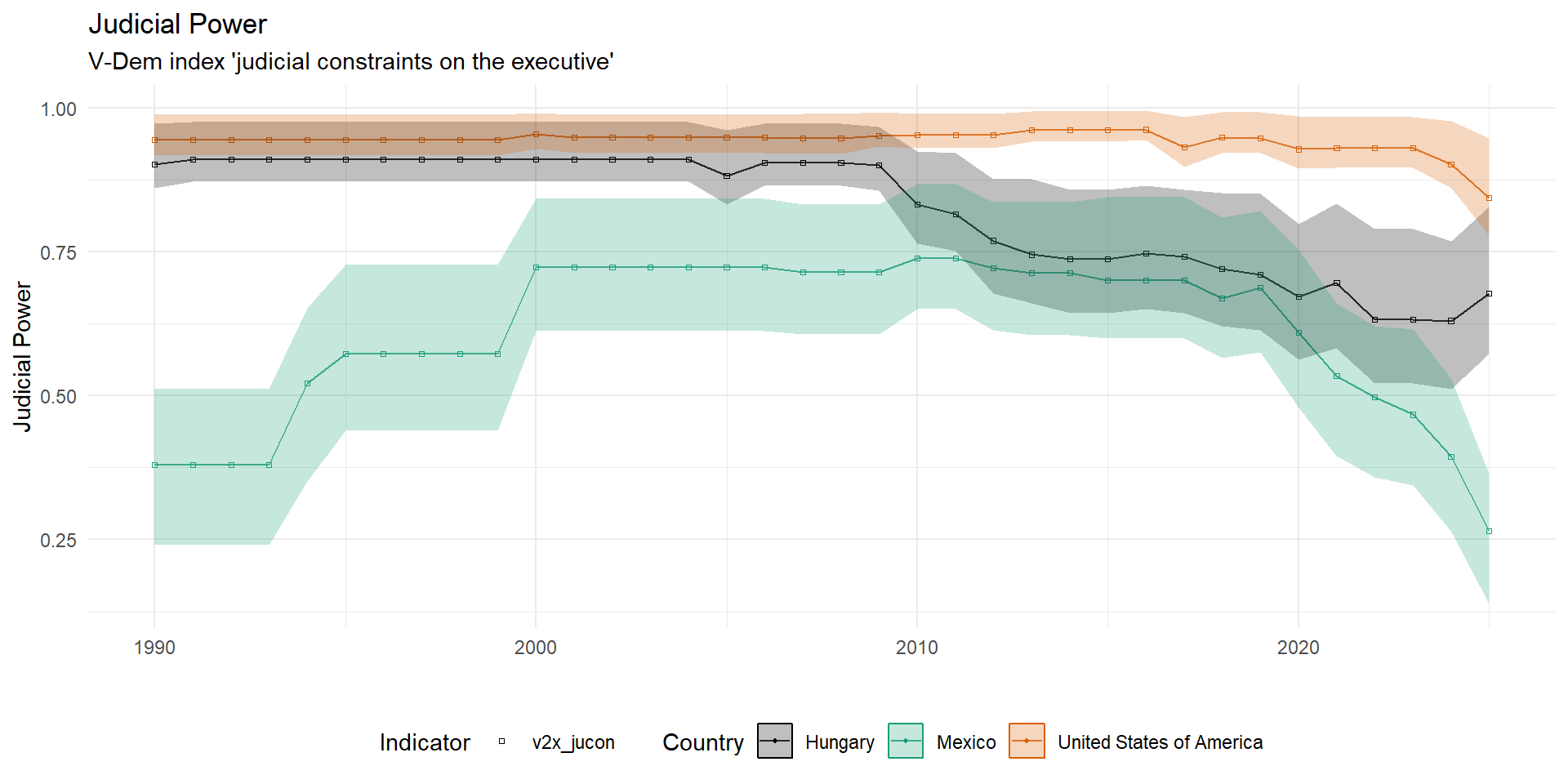
Judicial power in comparative perspective
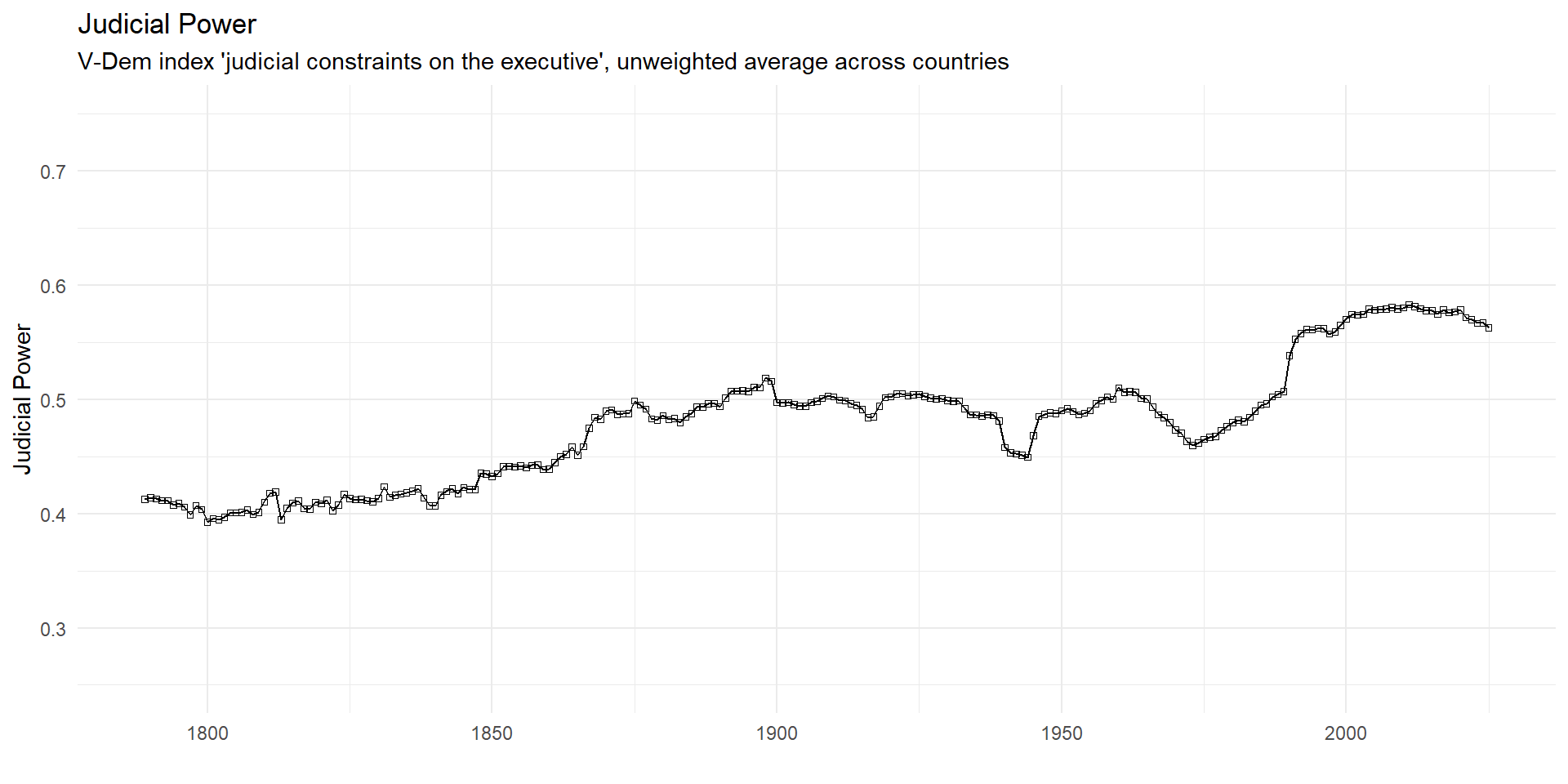
Judicial power in comparative perspective
How can courts increase their power?
new courts consolidate power by not antagonizing the government for an initial period (Epstein, Shvetsova, and Knight 2001)
expand jurisdiction through broad interpretation of access rules and legal domains
one strategy is to create a power-expanding principle without applying it in the initial case to avoid retaliation (Marbury) (Knight and Epstein 1996)
What makes judges autonomous?
judicial independence is widely seen as a core attribute of modern judiciaries
yet there is disagreement on the precise content of this concept
independence to do what? independence from what or whom?
Judicial independence
the degree to which judges actually decide cases in accordance with their own determinations of the evidence, the law and justice, free from the coercion, blandishments, interference, or threats from governmental authorities or private citizens. (Rosenn 1987, 8)
What is(n’t) judicial independence
can a judge be independent when the judiciary as a whole isn’t?
does “dependence” on another judge’s or court’s decision undermine judicial independence?
What is(n’t) judicial independence
what about anticipatory judicial behaviour?
- a court may self-censor if it knows the government is likely to override its decision
free from “governmental authorities or private citizens”
rulings based on “own determinations of … the law” vs “the law”
Measuring judicial independence
there are three main ways of measuring judicial independence
de jure measures code formal guarantees such as tenure and removal rules, so they are easy to compare but may not reflect practice
de facto measures rely on expert surveys (V-Dem), human rights reports (CIRIGHTS) or court rulings, so they are closer to practice but more subjective
latent measures combine many imperfect indicators into a single estimate (Linzer and Staton 2015)
de jure measures barely track de facto ones, which mostly agree with each other (Ríos-Figueroa and Staton 2014)
Measuring judicial independence
court rulings can be a misleading indicator (Ríos-Figueroa and Staton 2014)
a court that never rules against the government may be captured, or it may never have been asked to
a government that expects to lose may restrain its legislation in advance (Stone Sweet 2000)
References

POLS0113: Judicial Politics