How Judges Decide I: Theories and Preferences
Week 3
How do judges make decisions?
- modern judges are meant to apply legal rules to establish facts and decide disputes about the law
- in the process of doing so, they are frequently the ultimate authority deciding what the law “is” (and isn’t)
- in this module we will be more concerned with how judges make decisions rather than how they should make decisions
This week
this week we look at
why the law alone does not decide cases
attitudinal explanations and judicial preferences
economic and cognitive explanations
Legalism
Legalism
the legalist perspective
\[ decision = facts \times law \]
judges consistently apply legal rules to decide disputes
decisions are only guided by facts and the law
judges assess both facts and the law objectively
the ruling is an honest representation of the judge’s views
Legalism
assumptions behind the legalist perspective
there is one or “best” answer to any legal dispute
legal rules are determinate and contain solutions to problems
judges are capable of identifying the best legal answer to a problem
issues with the legalist perspective
judges have preferences and unconscious biases
there are often many overlapping rules
there are often many possible ways to decide a dispute (discretion)
Complexity of rules
Let’s consider the following simplistic case.
Law:
Rule 1: The government can force foreign companies to sell their assets if they threaten national security.
Rule 2: Companies are free to operate a business in the country.
Rule 3: Individuals have a right to express themselves freely.
Facts:
A company based in a rival country wields a lot of influence in the Country. Its service facilitates the freedom of expression of millions of people. It collects data about its users. It does not share the data with the rival government. The Government invokes Rule 1 and orders a sale of the company’s assets. The company disputes the legality of the order.
Complexity of rules
in a real legal system, there are millions of rules
- which subset of them should be applied in a case?
the interpretation of both facts and the law entails discretion
Ambiguity and disputes
Ambiguity and disputes
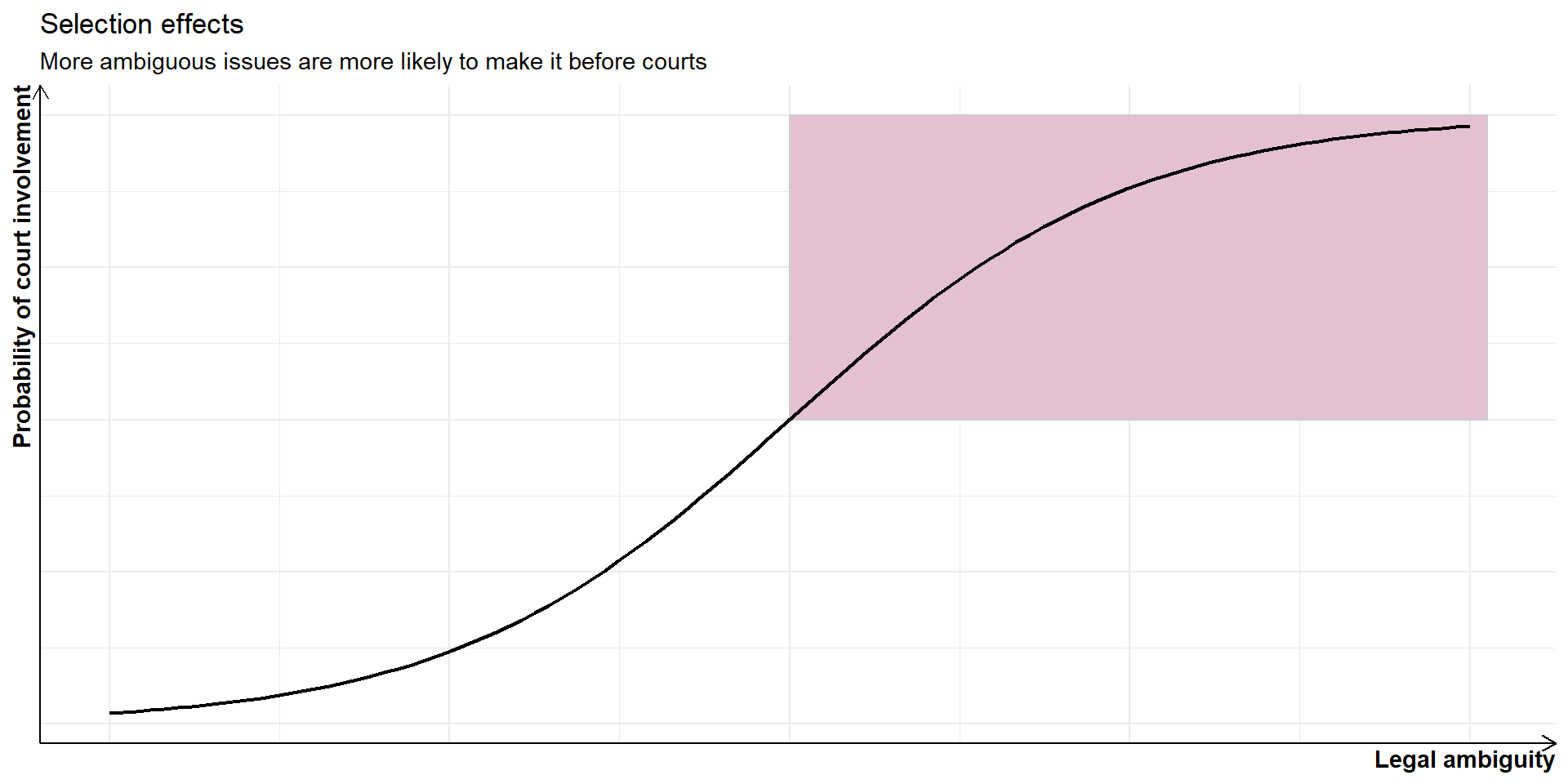
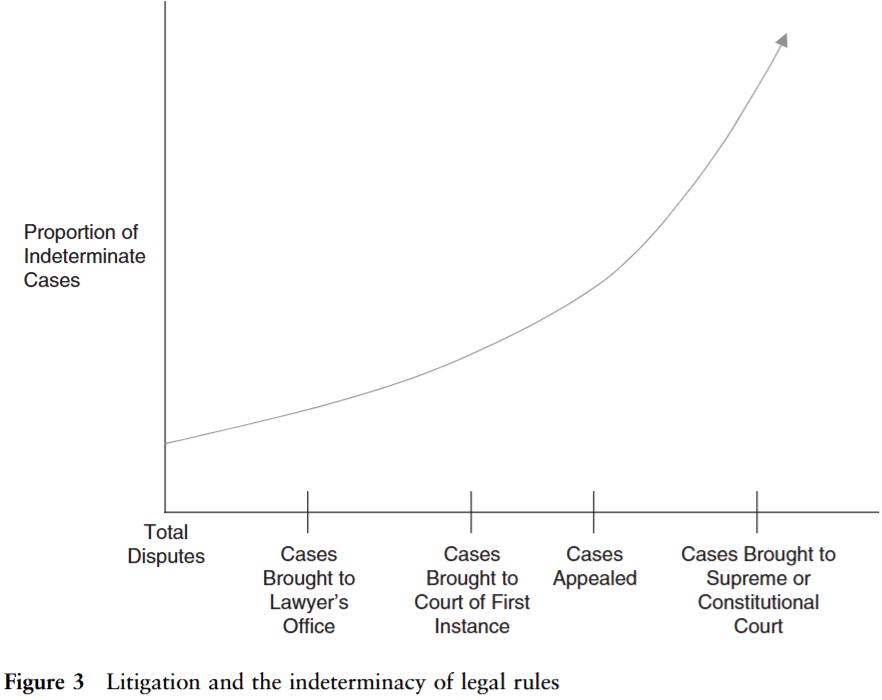
where the law is perceived as unambiguous, the parties are more likely to settle than litigate (Priest and Klein 1984)
- there will be exceptions, e.g. criminal trials (but settlements)
the more ambiguity, the more discretion a judge has in deciding
Ambiguity and disputes
Source: Dyevre (2010, 313)
Attitudinal explanations
Attitudinal explanations
the law alone does not determine case outcomes; judges’ attitudinal preferences matter more (Segal and Spaeth 2002)
originally motivated by the study of the US Supreme Court (SCOTUS)
judges have political preferences which can be ideological or even partisan
judges might seek desired policy outcomes consciously or subconsciously
The case space model
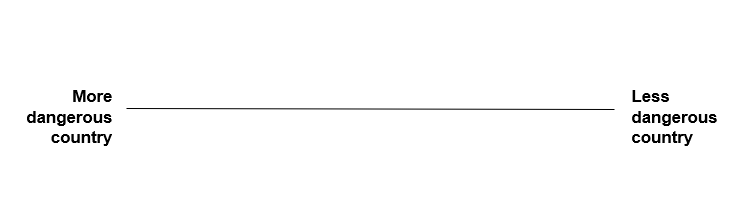
- imagine a one-dimensional space mapping countries by how dangerous they are to live in
The case space model
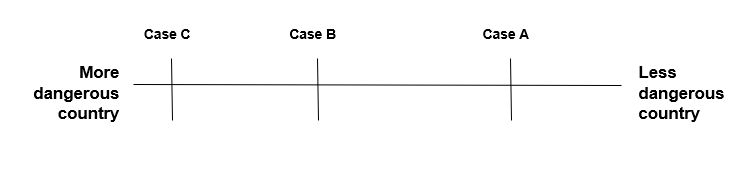
- imagine each case concerns an asylum application from a different country of origin
The case space model
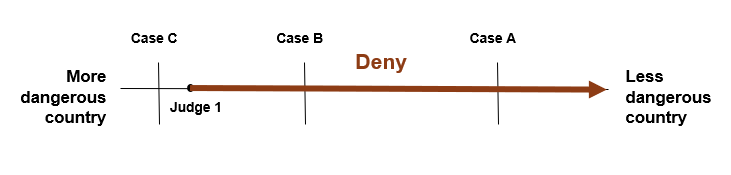
- the judge prefers to grant all applications to the left of their ideal point and to deny all applications to the right of it
The case space model
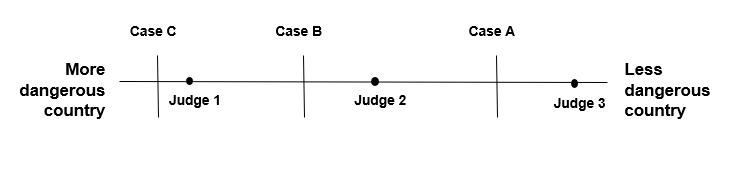
which judge is the most conservative?
which judge is the median judge?
Attitudinal explanations
SCOTUS votes can be predicted from newspaper editorials and other information about the nominees (Segal and Cover 1989; Cameron and Park 2009)
partisan identification predicts how US judges decide (Harris and Sen 2019)
- elsewhere other attitudes matter, e.g. religiosity in Israeli freedom of religion cases (Weinshall-Margel 2011)
many judicial attitudes can be mapped onto a left-right dimension of political conflict (Bonica and Sen 2021; Hanretty 2012)
decisions may also reflect who the judge and the defendant are
judges’ gender, race or ethnicity sometimes predict how they decide (Harris and Sen 2019)
attitudes towards groups such as immigrants may shape how defendants are treated (Riaz and Hamjediers 2025)
Attitudinal explanations
“judges’ decisions are a function of what they prefer to do, tempered by what they think they ought to do, but constrained by what they perceive is feasible to do” (Gibson 1983, 9)
attitudinal explanations are most relevant in “policy” cases, i.e. when matters of public policy play a role in the dispute
judicial preferences and decision-making are multidimensional – the identity of the median justice might vary by issue area (Lauderdale and Clark 2012)
Attitudinal explanations
a common objection to non-legal analyses of judicial behaviour is that disagreement between judges (or courts) is misrepresented as ideological
if this objection holds, disagreements about the law should not correlate with disagreements about policy
but e.g. Americans who prefer originalist interpretation of the constitution also tend to hold conservative policy views (Greene, Persily, and Ansolabehere 2011)
Learning about judicial preferences
Learning about judicial preferences
one of the most challenging tasks in the study of judicial behaviour is measuring judicial preferences
judges operate much more secretively than politicians and are therefore more difficult to approach (for interviews, surveys, experiments)
- even if we could ask judges about their preferences, it is unlikely they would answer sincerely (social desirability bias)
the most common way of learning about judicial preferences is by looking at what judges decide
pros: real behaviour (vs experimental hypotheticals); revealed (vs stated) preferences
cons: “post-treatment”; motivated reasoning; requires individual positions (on panels); comparability requires random case assignment
researchers also use the pitch of justices’ voices in oral argument (Dietrich, Enos, and Sen 2019)
Random assignment
judges rarely decide the same cases, so differences in their decisions may reflect differences in their cases
when cases are assigned at random, each judge gets a similar mix of cases on average
- e.g. if asylum appeals are allocated by lottery, a judge who grants fewer of them is likely to be stricter
experiments follow the same logic by randomly varying one feature of a case and keeping the rest the same
the logic breaks down if judges or parties can influence who hears a case
Economic explanations
Economic explanations
judges are self-interested agents who want to maximize their utility (Posner 1993)
on the one hand, judges care about reputation, salary, career progress and personal satisfaction
on the other hand, judges care about having free time
Economic explanations
making leisure time more attractive (e.g. basketball tournament) makes US appeals judges draft opinions more slowly and less well (Clark, Engst, and Staton 2018)
judges put quality before quantity and use spare time to handle each case more thoroughly (Ash and MacLeod 2015; Engel and Weinshall 2020)
judges seem intrinsically motivated to perform well (Ash and MacLeod 2015)
students given the role of judge in a lab game also take the office seriously (Engel and Zhurakhovska 2017)
judges write fewer opinions in years when they face contested elections (Ash and MacLeod 2015)
career incentives reward English judges who are rarely overturned and Japanese judges who defer to the government (Salzberger and Fenn 1999; Ramseyer and Rasmusen 2001)
Cognitive explanations
Cognitive explanations
less fully formed theories of decision-making and more studies of various types of cognitive ‘biases’
people are only boundedly rational and instead of conducting strictly rational calculations rely on (biased) heuristics (Tversky and Kahneman 1974)
there are a number of common cognitive heuristics, e.g. anchoring, framing, hindsight bias, which have been shown to affect judges (Guthrie, Rachlinski, and Wistrich 2001; Guthrie, Rachlinski, and Wistrich 2002)
Cognitive explanations
Anchoring: an initial value influences one’s perception of a reasonable estimate of a value.
Guthrie, Rachlinski, and Wistrich (2001) ask judges to award damages in a personal injury case – those exposed to an irrelevant low number awarded 29% less in damages on average
judges fined a nightclub more when its name (after its street address) was Club 11,866 rather than Club 58 (Rachlinski and Wistrich 2026)
young German lawyers gave longer sentences when loaded dice set a higher prosecution demand (Englich, Mussweiler, and Strack 2006)
Cognitive explanations
Framing: describing the same choice as a gain or as a loss changes what people choose.
people prefer a sure gain, but gamble to avoid a sure loss (Tversky and Kahneman 1981)
- e.g. a disease plan described as saving 200 of 600 people is chosen far more often than the identical plan described as 400 of 600 dying
judges advised plaintiffs to accept a sure gain more often than defendants to accept a sure loss, though both settlements were equally good deals (Guthrie, Rachlinski, and Wistrich 2001)
bankruptcy judges more often picked the safe reorganization plan when it was described as a gain (Rachlinski, Guthrie, and Wistrich 2006)
Cognitive explanations
legal training did not reduce motivated reasoning when law students judged how similar precedents were (Braman and Nelson 2007)
judges struggle to ignore inadmissible information (Wistrich, Guthrie, and Rachlinski 2005)
- and their written reasons justify the outcome with legal arguments instead (Spamann and Klöhn 2016; Liu and Li 2019)
Cognitive explanations
events unrelated to the case can also affect decisions
Louisiana juvenile judges with LSU undergraduate degrees gave longer sentences after an unexpected LSU football loss (Eren and Mocan 2018)
French and US federal judges give slightly shorter sentences on defendants’ birthdays (Chen and Philippe 2023)
some findings have been challenged
parole boards granted fewer requests the longer they went without a food break (Danziger, Levav, and Avnaim-Pesso 2011), but critics attribute this to case order and time management (Weinshall-Margel and Shapard 2011; Glöckner 2016)
US immigration judges appeared to grant less asylum on hot days (Heyes and Saberian 2019), but the effect largely disappears once coding errors are fixed (Spamann 2022)
Realizing judicial preferences
judicial preferences manifest most importantly in decisions
judges’ ability to realize their preferences is constrained to varying degrees
by the facts of the case, the law, the preferences of other deciding judges (panel decisions) and of other actors (e.g. the legislature)
judges who anticipate these constraints are acting strategically (Epstein and Knight 1998)
References

POLS0113: Judicial Politics