Legal Mobilization
Week 5
Assessment
the deadline and submission instructions will be on the module’s Moodle page
- draft deadline: 15 December 2026
what theory do you want to contribute to with your empirical analysis?
- derive a specific hypothesis from theoretical discussion
what data are you going to use to test your hypothesis?
what method are you going to use to analyse your data?
Empirical paper
Introduction: what is the research puzzle/problem and why is it important?
Literature review: what we already know about the problem from previous research and what gap is going to be addressed by your paper
- examples of a gap: all evidence comes from a single jurisdiction; there is conflicting evidence; existing theories do not account for an important variable; etc.
Theory: a reasoned justification of (the logic behind) your principal expectation (hypothesis) prior to conducting the empirical analysis; must be informed by existing literature
what puzzle does your theory attempt to explain?
example of a hypothesis: “The likelihood of [Supreme Court] review should initially decrease and then increase in ideological distance [from the lower court].”
what is your explanatory (independent) variable? What is your outcome (dependent) variable?
Empirical paper
Data: information used to produce evidence and test your hypothesis
which cases will offer leverage on your research problem?
how do you operationalize your variables? What is the unit of analysis?
what measurement choices were made in the construction of the dataset?
you can use an existing dataset or collect your own data
even in qualitative research keep meticulous track of your sources (transparency appendix)
Methods/research design: the empirical strategy used to test your hypothesis
how do you analyse your data?
what inferences does your method allow? e.g. average treatment effects vs mechanistic evidence
what are the assumptions and limitations of the method?
Empirical paper
Findings and discussion: the results produced by your empirical strategy and data
what are the results of your analysis?
what are the implications for your hypothesis? is there evidence in support of or against it?
what are the implications for the broader theory and literature?
what have we learned that we did not know before?
Conclusion: summarize findings, highlight main contribution and limitations, and offer thoughts on policy and future research avenues
Legal mobilization
What kinds of individuals and groups resort to litigation?
What influences the likelihood of interest group litigation and what makes their success likely?
courts are passive and nothing happens until someone brings a case
Legal mobilization
legal mobilization, or invoking legal norms, is “a form of political activity by which the citizenry uses public authority on its own behalf” (Zemans 1983)
the enforcement of the law often depends on private (non-governmental) actors (Zemans 1983)
- traditionally in the US (“adversarial legalism”), possibly also in the EU (Kelemen 2012)
Adversarial vs bureaucratic legalism
law and policy in the US are strongly shaped by means of “lawyer-dominated litigation” (Kagan 2001)
economic liberalization and political fragmentation in the EU have been argued to be leading Europe down the American path (Kelemen 2012)
in EU competition and securities law, public agencies rather than private litigants still do most enforcement (Foster 2024)
Legal mobilization
“the process by which individuals make claims about their legal rights and pursue lawsuits to defend or develop those rights” (Epp 1998, 18)
“claims” not strictly invoking formal institutional mechanisms
what exactly counts as legal mobilization is contested (Lehoucq and Taylor 2020)
Why mobilize the law?
often targeting legal change through courts (“strategic litigation”)
raise rights consciousness and improve receptivity to claims
generate media attention and public support
Why not?
fear of creating negative precedents entrenching unfavourable outcomes
critics argue that judicial review of legislation lacks democratic legitimacy (Waldron 2006)
fear of backlash against the pursued cause (Klarman 1994)
- but other forms of policy change can also generate backlash (Keck 2009)
Individuals
From injury to lawsuit
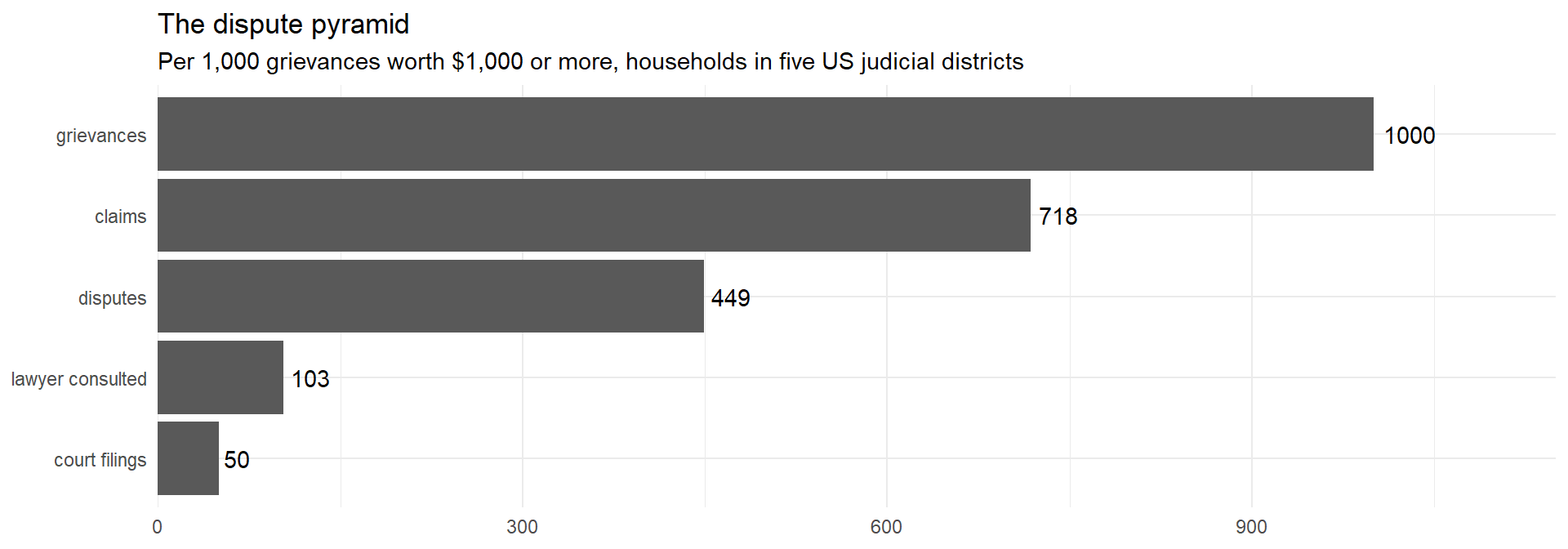
most injuries never become disputes, let alone court cases (Felstiner, Abel, and Sarat 1981)
- an injury has to be perceived (naming), attributed to someone (blaming) and put to them (claiming)
each step is subjective and unstable, and lawyers, officials and friends can reshape it (Felstiner, Abel, and Sarat 1981)
Source: R. E. Miller and Sarat (1981)
Legal mobilization in Costa Rica
in 1989, the Costa Rican constitution was reformed to create a constitutional chamber in the Supreme Court
Wilson and Rodríguez Cordero (2006) argue that poorly organized marginalized groups won significant cases because access was cheap and easy
an extensive list of constitutional rights also made these wins possible
Legal mobilization in Costa Rica
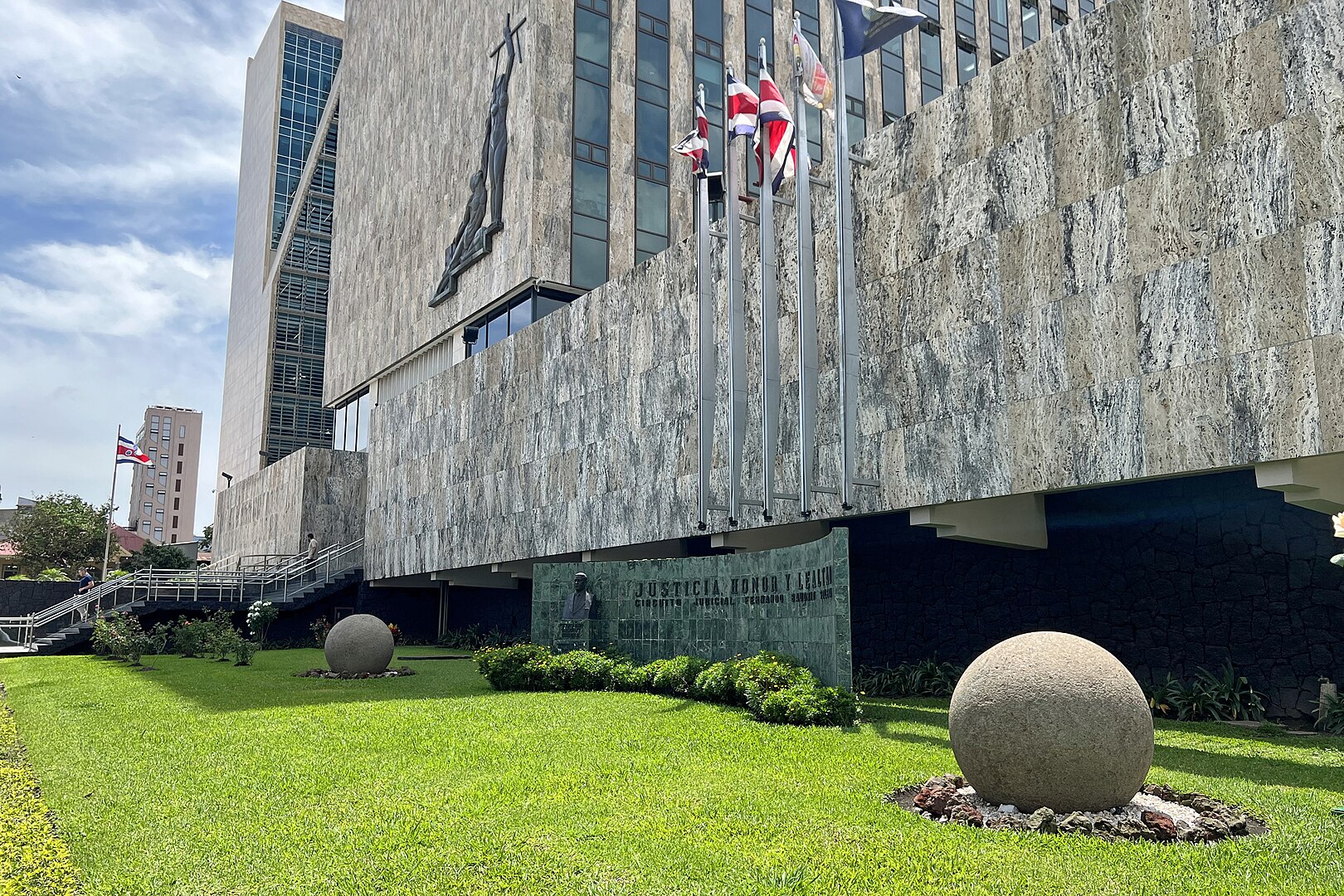
The building of the Costa Rican Supreme Court
Individuals without organizations
Colombia’s acción de tutela (1991): any person can file a complaint for the protection of a fundamental right, without a lawyer, and get a decision within ten days
hundreds of thousands of tutelas are filed each year (Taylor 2018)
Colombians report very low trust in the judiciary and file tutelas in enormous numbers anyway (Taylor 2018)
cheap tutelas suit individual claims, while costly South African courts favour NGO-backed collective claims (Taylor 2020, 2023)
cheap access can replace the support structure that Epp (1998) treats as crucial (Wilson and Rodríguez Cordero 2006)
Organizations
The drivers of legal mobilization
legal mobilization requires the capacity to navigate a complex organizational field
actors need to have the necessary resources (financial, expertise) to take advantage of the available legal opportunity structure (LOS)
- but LOS is not just exogenously given, acting on it shapes it going forward (Vanhala 2012)
Legal opportunity structure (static)
legal stock
- what rights and laws are available to “hang” your case on?
access to justice
- who can access the procedure and under what conditions?
legal costs
- how expensive is it to access the procedure and is legal aid available?
Legal opportunity structure (dynamic)
the text of a law is only the starting point
- rules need to be interpreted in the process of being applied
actors attempt to mould LOS to their advantage by advancing new interpretations
mostly before judges, but also e.g. MPs, ombudsmen
some might not see an opportunity where there is one (Pas 2024)
Empirical examples
civil rights movements
Brown v Board of Education of Topeka (1954)
open LOS in US v closed LOS in NI (De Fazio 2012)
Empirical examples
environmental movements (Vanhala 2022)
Aarhus Convention
climate litigation (Setzer and Vanhala 2019; Voeten 2025)
Empirical examples
LGBTQ+ movements (Keck 2009)
decriminalization, recognition, same-sex marriage
international courts can help (Helfer and Voeten 2014)
Litigate or lobby?
groups with good access to policymakers lobby; those shut out, or aiming at settled law rather than new law, litigate (Bouwen and McCown 2007)
a German survey of organized interests, including firms, links litigation frequency to legal staff and membership structure (Thierse and Meftha 2026)
- there is no evidence that richer organizations litigate more often
so legal expertise may matter more than money, at least in Germany
Mobilizing the law from the right
the literature grew up around progressive movements, but conservatives litigate too (Escoffier, Payne, and Pereira 2026)
Colombian conservatives fought LGBT rights in Congress and the streets until 2007, then in the Constitutional Court once its rulings threatened them (Lehoucq 2021)
is this backlash, or simply mobilization by the other side?
Role of international law
chances are the LOS is in a stable equilibrium due to well-defined and entrenched preferences of the executive, legislature and courts
there is a huge literature on international law and courts disrupting such domestic equilibria and creating new opportunities for actors (Helfer and Voeten 2014; Simmons 2009; Alter and Vargas 2000; Pavone 2019)
- domestic political players have less control over the international LOS
Lawyers
Lawyers as mobilizers
the founding story of EU law has rights-conscious litigants and activist judges
- in fact Euro-lawyers found clients, built test cases and ghostwrote referrals that reluctant national judges sent to Luxembourg (Pavone 2022)
cause lawyers commit their legal skills to a political cause as well as to the client’s case (Sarat and Scheingold 1998)
- this commitment sits uneasily with professional norms of neutrality
does having a lawyer matter? in a randomized experiment in New York’s housing court, tenants given free counsel were far less likely to face judgments or eviction orders (Seron et al. 2001)
lawyers are repeat players even when their clients are not (Galanter 1974)
Who litigates and who wins
Who litigates?
as late as the mid-1930s, under 10% of SCOTUS decisions involved individual rights other than property (Epp 1998)
by the late 1960s almost 70% of its decisions involved individual rights
- rights groups such as the ACLU and NAACP sponsored the leading cases
India’s Supreme Court tried to spark a rights revolution in the late 1970s but little happened (Epp 1998)
disagreement about the importance of the “support structure” (Sanchez Urribarri et al. 2011; Epp 2011)
Who litigates?
the equalizing potential of the law is limited in practice by resource inequality (Galanter 1974)
more resourceful actors litigate more (Hofmann and Naurin 2021)
- but the groups with the most sustained ties to the US EPA sue it most often (Coglianese 1996)
some repeat players are just chronically bad businesses who also lose cases (Volkov, Skougarevskiy, and Kuchakov 2023)
- decouple party capability from repetitiveness
Who wins?
repeat players with organizational strength are much more likely to win in US appeals courts (Songer, Sheehan, and Haire 1999)
governments tend to beat weaker parties, and the US federal government dominates its opponents (Wheeler et al. 1987; Songer, Sheehan, and Haire 1999)
Who wins?
government lawyers tend to be more successful than private lawyers
e.g. SCOTUS granted 76% of the US Solicitor General’s certiorari petitions in its 1984 term but only 4% of others (Epp 1998)
justices follow the Solicitor General’s recommendations at the agenda stage even when they oppose them (Black and Owens 2011)
justices heed the Solicitor General more when the two are ideologically close (Bailey, Kamoie, and Maltzman 2005)
Who wins?
broad evidence base showing that party capability predicts success before courts (Wheeler et al. 1987; McCormick 1993; Songer, Sheehan, and Haire 1999)
attorney experience at SCOTUS (Nelson and Epstein 2022) and attorney quality in US immigration courts (B. Miller, Keith, and Holmes 2015) help litigants win
the “haves” hire better lawyers, and these lawyers help them win more often (Szmer, Songer, and Bowie 2016)
Who wins in international courts?
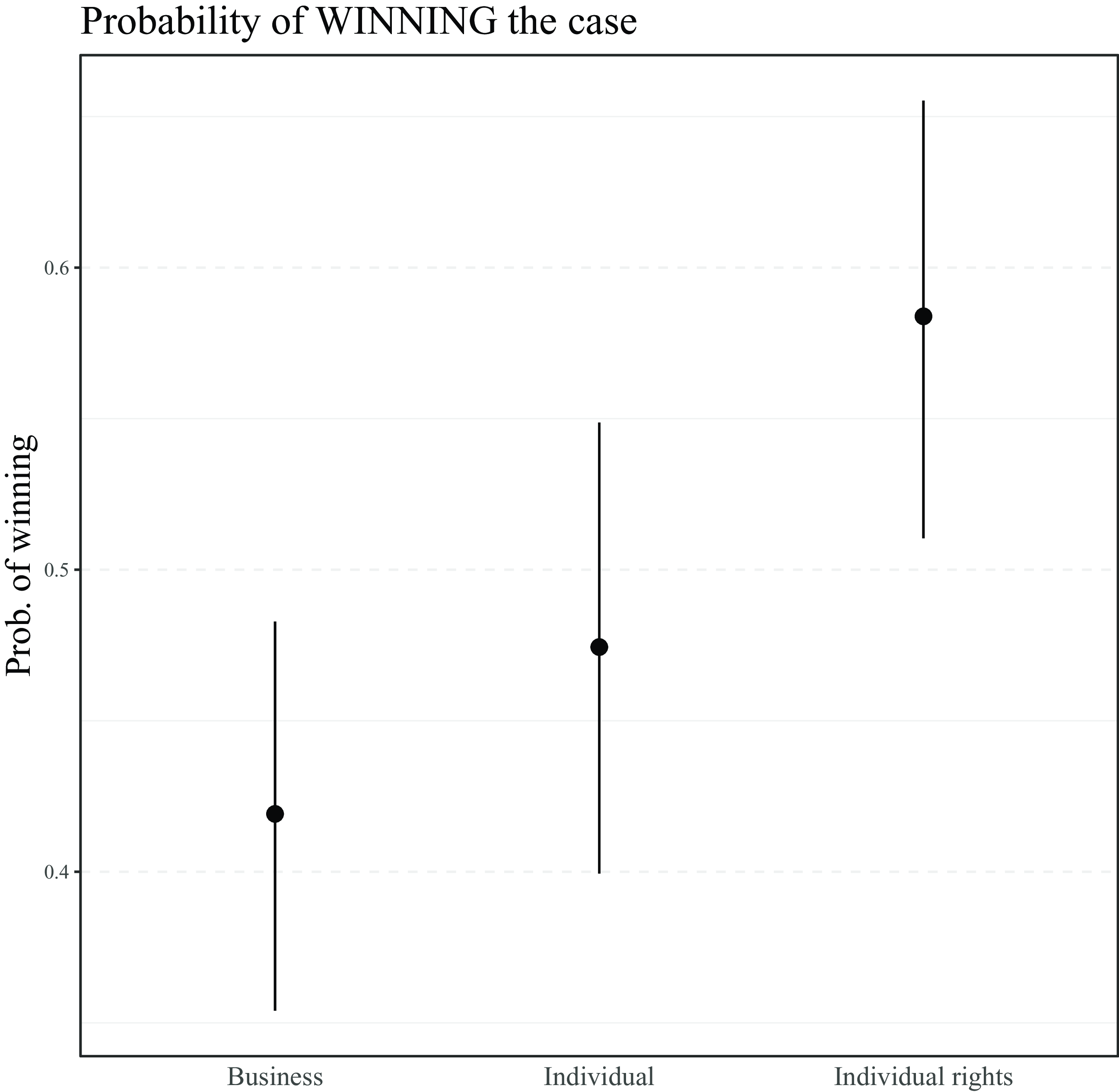
Hermansen, Pavone, and Boulaziz (2025) ask whether international courts amplify the power of the already powerful
they find that instead the ECJ favours less privileged litigants (“leveling”) and “spotlights” those rulings which enhance individual rights
this suggests the ECJ is consciously trying to build up its legitimacy
Who wins in international courts?
Source: Hermansen, Pavone, and Boulaziz (2025)
References

POLS0113: Judicial Politics