Legislative Output of the European Union
An automatically updated overview of the EU’s legislative activity
The European Union is often criticized for having a heavy regulatory touch. What is the reality? This page provides an automatically updated overview of the EU’s legislative output and efficiency, sourced from Eur-Lex via the eurlex R package.1
As of 4 October 2026, the EU and its predecessors have produced 144,732 regulations, 4,409 directives, 39,933 decisions and 1,643 recommendations.
Data as of 2026-10-04 09:48 UTC
The following table shows the most recent legislation:
Number of acts over time
We start by looking at how the number of the four main legal acts changed over the lifespan of the EU. The number adopted yearly is a parsimonious proxy for the EU’s regulatory tendencies.
Proportion of act types
Some types of acts, notably regulations, have been historically more common than others. We can visualize the evolution of proportions directly.
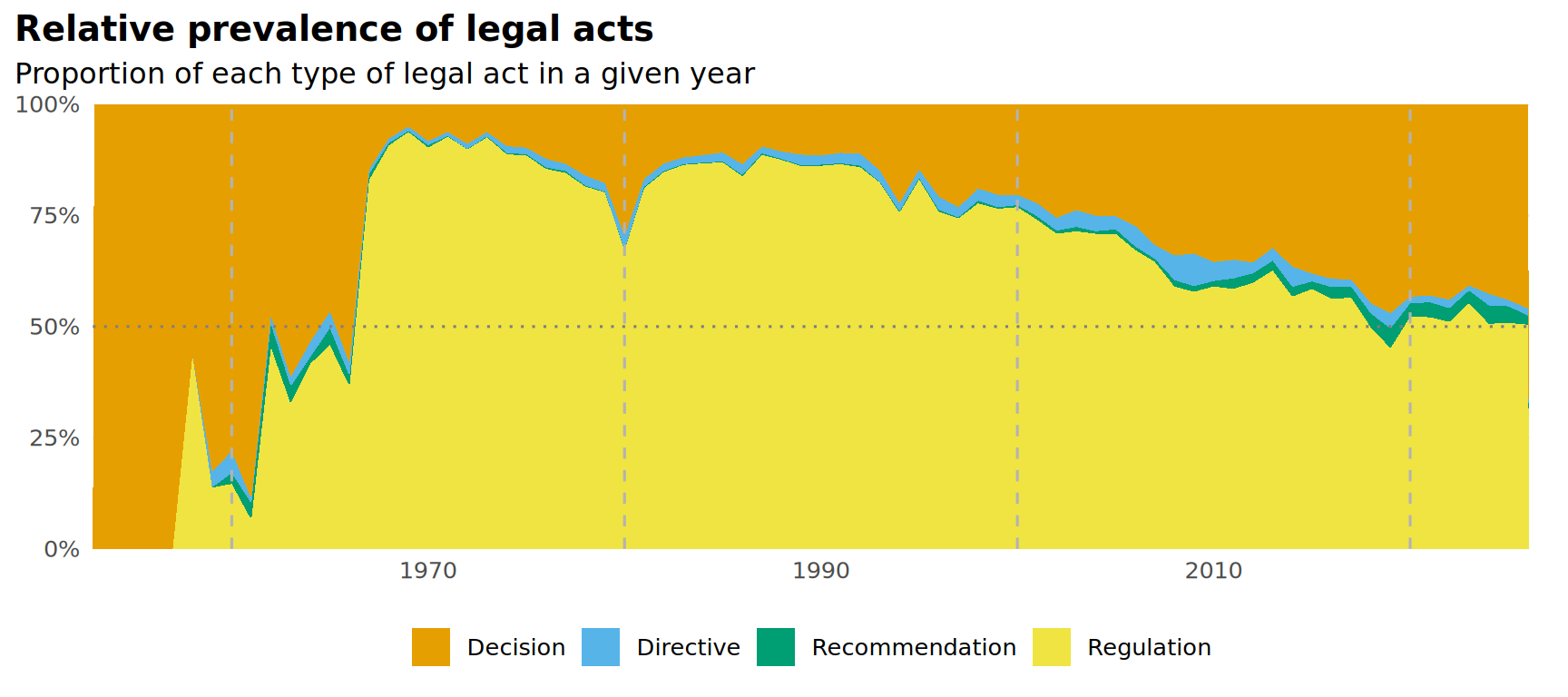
Although regulations used to dominate the EU’s legislative output, decisions (typically associated with administrative actions) are nowadays almost equally prevalent.
Year-on-year comparison
We can look at the extent to which monthly adoption rates this year differ from last year.
Acts in force
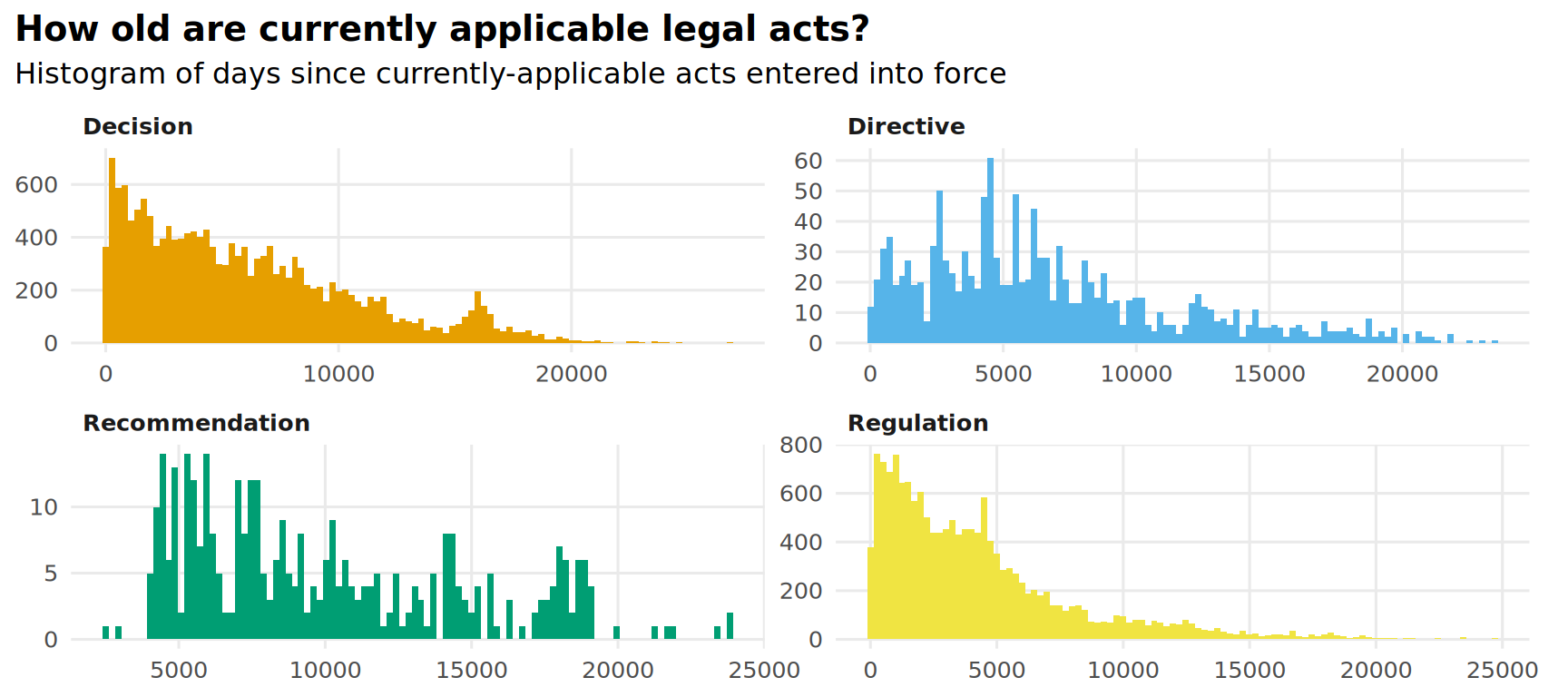
Not all legal acts remain in force indefinitely. According to Eur-Lex, the EU has 46,170 acts in force at the moment.
EU law tends to be cumulative: many acts adopted in any given year amend or implement an earlier one.
Proposals
Behind every adopted act is at least one Commission proposal. The EUPROPS dataset (curated through 2022) corrects systematic errors in Eur-Lex’s proposal metadata; we combine it with the nightly Eur-Lex pull for the post-2022 tail. Total proposals in scope: 31,160, of which 28,624 led to at least one adopted act and 1,773 were withdrawn, rejected, replaced or never adopted.
Note: EUPROPS coverage of recommendations is very thin (fewer than 30 records across its 70-year span), so EUPROPS-driven charts on this page restrict themselves to the three main types (regulations, directives, decisions). The act-side counts shown earlier in the page draw on the complete Eur-Lex acts table and do include recommendations.
Decisions are by far the most numerous category. Directives are the rarest, reflecting their heavier political weight (a directive binds Member States as to result but lets them choose form and methods).
Legislative efficiency
The image of the EU as an unwieldy bureaucracy is widespread. Let’s use EUPROPS-corrected dates (more reliable than raw Eur-Lex for older proposals) to find out how long it normally takes to pass legislation.
| Baseline | With type controls | |
|---|---|---|
| + p < 0.1, * p < 0.05, ** p < 0.01, *** p < 0.001 | ||
| (Intercept) | 145.164*** | 57.906*** |
| [130.423, 159.906] | [43.413, 72.400] | |
| n_ms | 4.326*** | 4.715*** |
| [3.595, 5.056] | [4.093, 5.337] | |
| proposal_typeDirective | 596.245*** | |
| [582.423, 610.066] | ||
| proposal_typeRegulation | 26.780*** | |
| [17.733, 35.827] | ||
| Num.Obs. | 16289 | 16289 |
| R2 | 0.008 | 0.328 |
| R2 Adj. | 0.008 | 0.328 |
| AIC | 234677.3 | 228333.8 |
| BIC | 234700.4 | 228372.3 |
| Log.Lik. | -117335.645 | -114161.920 |
| RMSE | 325.20 | 267.63 |
Controlling for type, the model suggests that each additional Member State adds a few days to the average adoption time of a legal act.
Legal bases
Each EU legal act has a legal basis in the Treaties or in pre-existing EU law. Looking at the most-invoked legal bases gives insight into EU legislative activity.
The most-invoked legal basis historically is Council Regulation (EC) No 139/2004 of 20 January 2004 on the control of concentrations between undertakings (the EC Merger Regulation), used as a legal basis on 7,210 occasions.
Nonetheless, when we think of legal bases we usually imagine a Treaty competence. Filtering to legal bases in the Treaty on the Functioning of the European Union (TFEU) and Treaty on European Union (TEU), the following table lists the most-invoked Treaty competences since the entry into force of the Treaty of Lisbon.
Treaty articles are not the only possible legal basis. Many acts are adopted under powers conferred by earlier EU legislation rather than grounded directly in the Treaties. The chart below tracks how the balance between primary acts (those citing a Treaty) and delegated acts (those citing other EU law) has shifted over time.
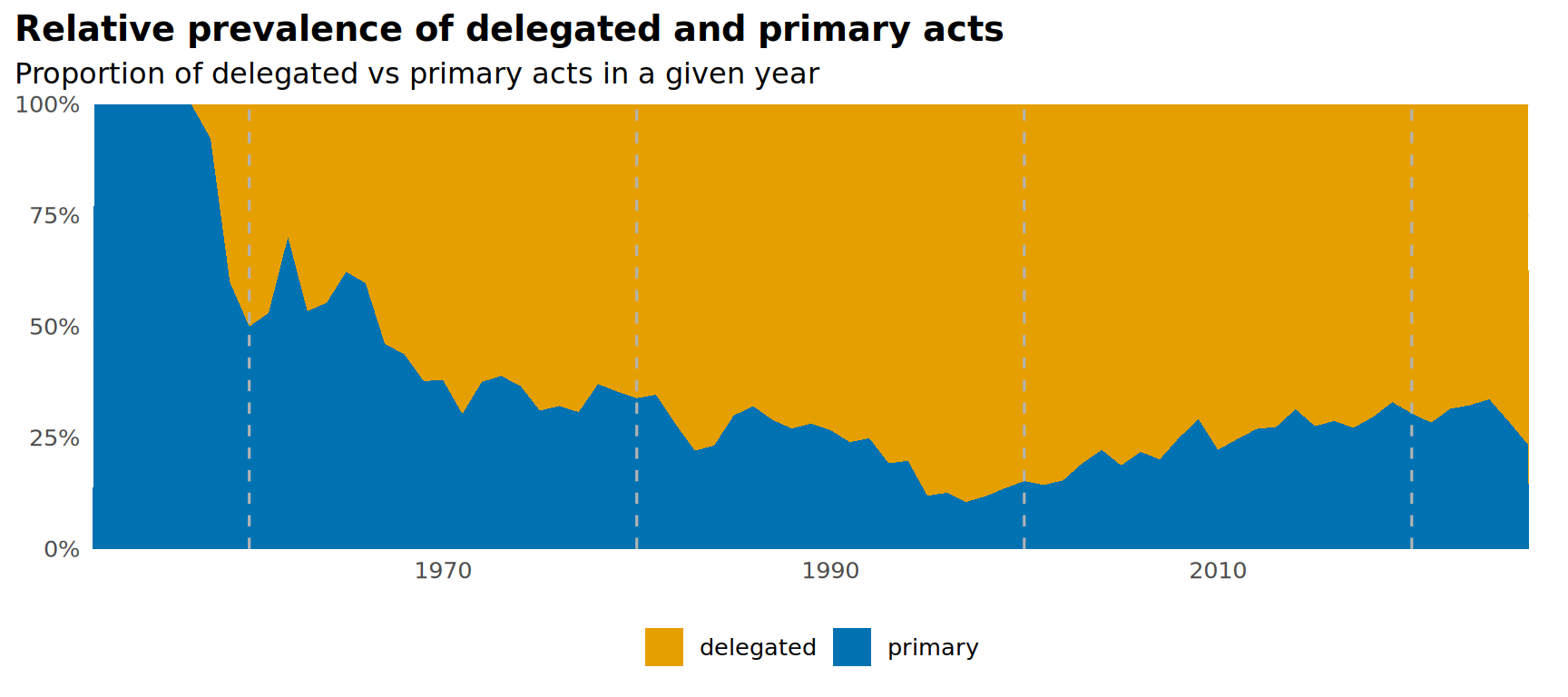
Most legal acts adopted by the EU are delegated and implementing acts, based on another piece of legislation rather than directly on a Treaty.
Cite
Ovádek, M. euverse: Legislative Output of the European Union. Accessed 4 October 2026. Available at https://michalovadek.github.io/euverse/trackers/eu-law.html.
Footnotes
Any omissions or mistakes in Eur-Lex carry through to the output shown here.↩︎